
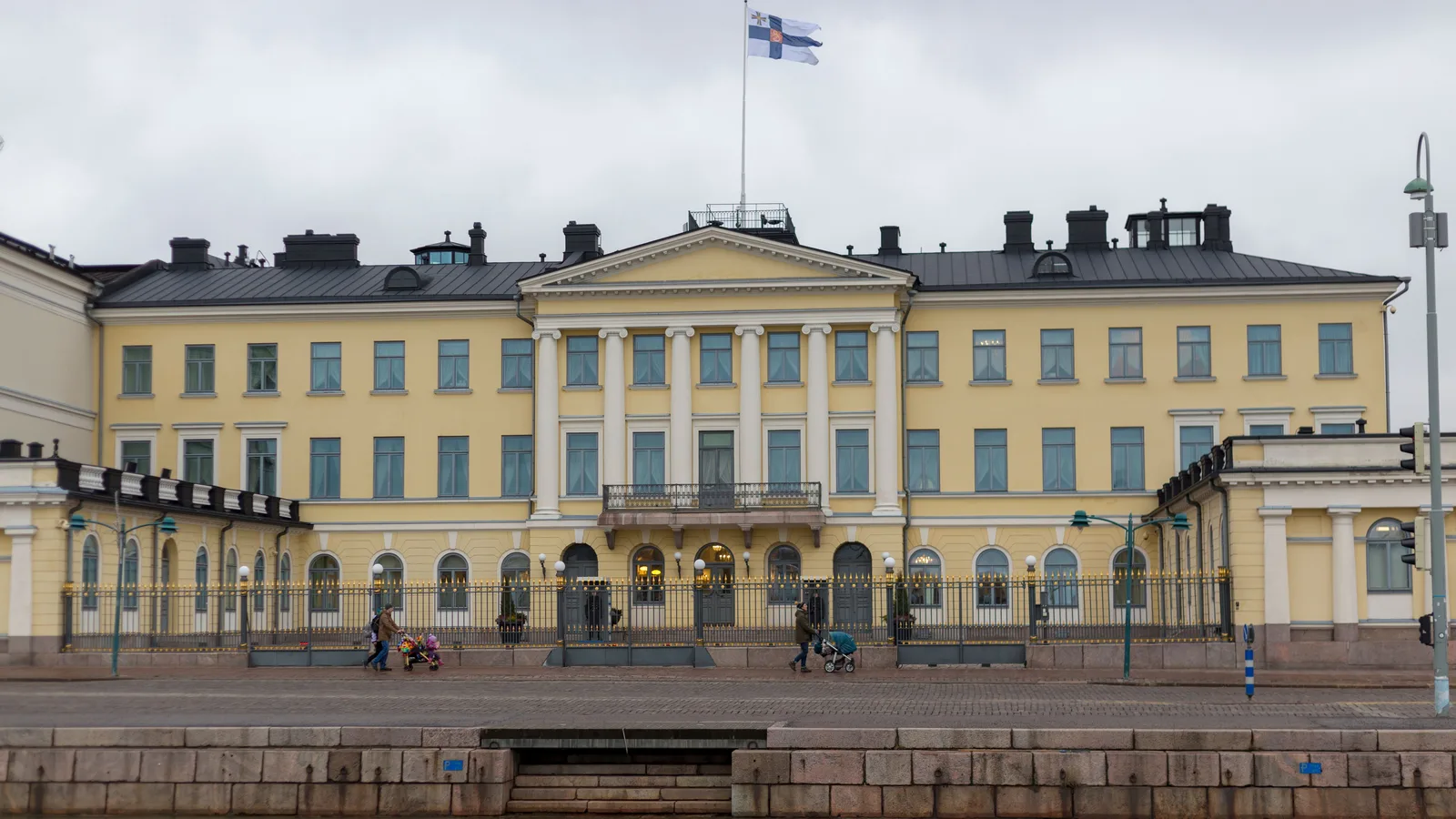
On Monday in Bruges, Alexander Stubb told the new students of the College of Europe that "Europe is probably more united today than ever before". It is in the speech, in the part about what he called our current "Era of Darkness".
On Tuesday morning, Finland's president sat down in Helsinki next to Norway's prime minister, Jonas Gahr Støre, and the two of them phoned Vladimir Putin.
By lunchtime Denmark's prime minister was telling her national broadcaster she was "very sceptical". By the afternoon Sweden's prime minister was warning against "appeasement", Estonia's foreign minister was reminding everyone about unity, and the European Commission had put out the diplomatic version of a raised eyebrow.
So much for the most united Europe ever. But the row tells you more about Europe than the call does.
Twenty minutes booked, ninety used
The facts first. According to the Finnish president's office, the two Nordic leaders initiated the call as a follow-up to last week's talks in Oslo with Volodymyr Zelensky and Donald Trump's envoy Steve Witkoff. Ukraine was consulted beforehand. They spoke "as leaders of their respective countries" and "not on the behalf of Europe as a whole". Støre told NRK that twenty minutes had been set aside. It lasted ninety.
Leaving aside Robert Fico and Viktor Orbán, it was the first leader-level call between Putin and one of Ukraine's European backers since Emmanuel Macron's in July 2025, Politico reports.
Moscow's readout was short and pointed. It opens by noting that the call came "at the request of the Finnish and Norwegian sides". The Kremlin wanted everyone to know who had picked up the phone. Putin then repeated that peace is possible only if Russia's interests are "considered in full and without any conditions attached", and blamed "the EU and NATO's confrontational policies" for dragging the war out.
So, on substance, nothing moved. Nobody in Helsinki claimed otherwise. Stubb talked of "very restrained optimism" about the trilateral talks planned in Abu Dhabi, according to Poland's Donald Tusk. Støre spoke of big differences in views. What they got was an open line: the Kremlin says all three agreed "to maintain direct telephone contact", ahead of the US-brokered talks between Russia, Ukraine and America due in early to mid November.
That is not much. It is also not nothing. Until Tuesday, no leader among Ukraine's European backers had spoken to Putin in more than a year.
The complaint was about the seating plan
Then the reaction. Mette Frederiksen said the initiative had not been "co-ordinated with any of the rest of us". "I actually don't know what they think you can achieve with this," she added, according to Euronews. Europe should stay "united rather than going it alone".
Frederiksen is no dove. Denmark has been one of Kyiv's most determined backers, and she is right that Putin has shown no wish for peace with Europe. But read the complaint again. It is not that Stubb and Støre said the wrong thing. It is that they had not been cleared to say it.
And they appear to have asked. Støre said all partners and allies were told in advance. Tusk confirmed he was consulted. Two EU officials told Politico that António Costa, the European Council president, had been informed. Ukraine's foreign minister, Andrii Sybiha, called the coordination "the right approach". The people whose country is being bombed approved the call. Some of the people whose countries are not were annoyed about the procedure.
Brussels takes note
The Commission's line was a small masterpiece. "We take note of the call, which took place solely on a bilateral basis," spokesperson Paula Pinho said, as quoted by Politico. Then: "The EU is involved."
Involved how, exactly? Euronews reports that the Commission and the Council are working to set up a combined team to represent the EU position. For months Brussels has demanded a seat at the table. Even the Kremlin's spokesman said last weekend that a European negotiator would be "good". Brussels' answer, so far, is an arrangement between the Commission and the Council about who sits where.
Meanwhile, the only European line to the Kremlin that worked this week ran through Oslo. Norway has voted twice not to join the EU, in 1972 and 1994. In Bruges, Stubb said he would like to see it in. On Tuesday it was helping to do the job the Union keeps saying it wants to do.
Why it was the Nordics
This is no accident. Finland shares a border of some 1,300 kilometres with Russia. Norway borders it in the Arctic. Both are among Ukraine's biggest military donors, and both told Putin that support would continue. "We are neighbouring countries to Russia," Stubb said. "The outcome of this war will have a direct impact on our and the broader European security."
That is where diplomatic credibility comes from: weapons delivered, a border to defend, and voters who will live with the outcome. National governments with skin in the game can do what a spokesperson in Brussels cannot. A Europe of nations is not a weakness here. It is the part of Europe that Moscow actually takes seriously.
Unity is a tool, not a policy. If it comes to mean that no European may speak until twenty-seven have agreed, Putin gets the Europe he wants anyway: an absent one. Friedrich Merz, speaking in Singapore on Tuesday, warned against a deal struck by "Russia, perhaps China and the United States of America" without Ukraine. DW reports that Moscow is pushing exactly that: a Trump–Putin–Xi table with no seat for Kyiv or the EU. That is the real danger this autumn, not two Nordic leaders with a telephone.
The critics' fair point
The sceptics are not wrong about everything. Ulf Kristersson said peace "must be brought about through strength, and not through appeasement". Estonia's Margus Tsahkna said there is "no indication that Russia has changed its strategic objectives". Both are correct. Putin used the call to blame Europe for his own war, and the risk with calls to the Kremlin is that the call itself becomes the product.
So hold the Nordics to a test. The call is justified only if it serves Abu Dhabi, and only if what they carry there is backed by arms and money rather than hope. If that happens, Europe should be glad someone made the call. If it does not, Frederiksen will have been right, for the right reasons.
In Bruges, Stubb also said: "I think the Helsinki Accords of 1975 worked." They did, eventually. They were signed in his own capital, after two years of talks between governments that agreed on very little. Nobody waited for Europe to be united before starting. Tuesday's call was small. The reaction to it was smaller.