
The number landed in the early hours of Friday, and it is not a headline you can shrug off: 50,391 people died from heat in Europe's cities between June and August.
That is the central estimate from a new study by researchers at Imperial College London and the London School of Hygiene and Tropical Medicine, covering 854 cities and about 173 million people. It is almost double their estimate for 2025 (24,572) and far above the infamous summer of 2003 (28,462). The authors attribute about two-thirds of the deaths to human-caused warming. The highest death rates were in Malta, Italy, Hungary and Croatia.
Within hours, the conclusion had written itself. Europe must cut emissions faster. Climate breakdown is killing us. More ambition, please.
There is something in that. But read the paper, not the press release, and a more awkward story appears. It is about who actually died, what would have saved them, and what Brussels is about to offer instead.
Who died
Of the 50,391, the study puts 22,502 among people aged 85 or over. That is 45% of the toll in a single age band. Among adults aged 20 to 44 the estimate is around 833.
The paper is candid about why southern Europe suffers most. The death rates there reflect not only the heat, but "greater population vulnerability", the authors write, due to factors such as "prevalence of chronic diseases, demographics, socioeconomic deprivation, air-pollution exposure and green space coverage".
Look at that list again. Every item on it is something a health minister, a mayor or a landlord can change before next June. Nowhere on it is the global thermostat.
The study's own final line asks for "rapid emissions reductions alongside preparation and adaptation measures." Mark the word alongside. In Brussels, only the first half of that sentence ever gets a press conference.
The thermostat isn't in Brussels
Here is the arithmetic the European debate prefers to skip. According to the Commission's own Joint Research Centre, the EU produced 5.9% of the world's greenhouse gas emissions in 2024. The same Imperial paper notes that, under policies already in place worldwide, another 1.4°C of warming is projected by the end of the century.
You can believe every word of the attribution science, and this newspaper does, and still see the problem. If the EU stopped emitting tomorrow, next July would not be measurably cooler in Palermo. The heat is coming either way. The only question Europe controls is how many people it kills.
The cheap fix nobody likes
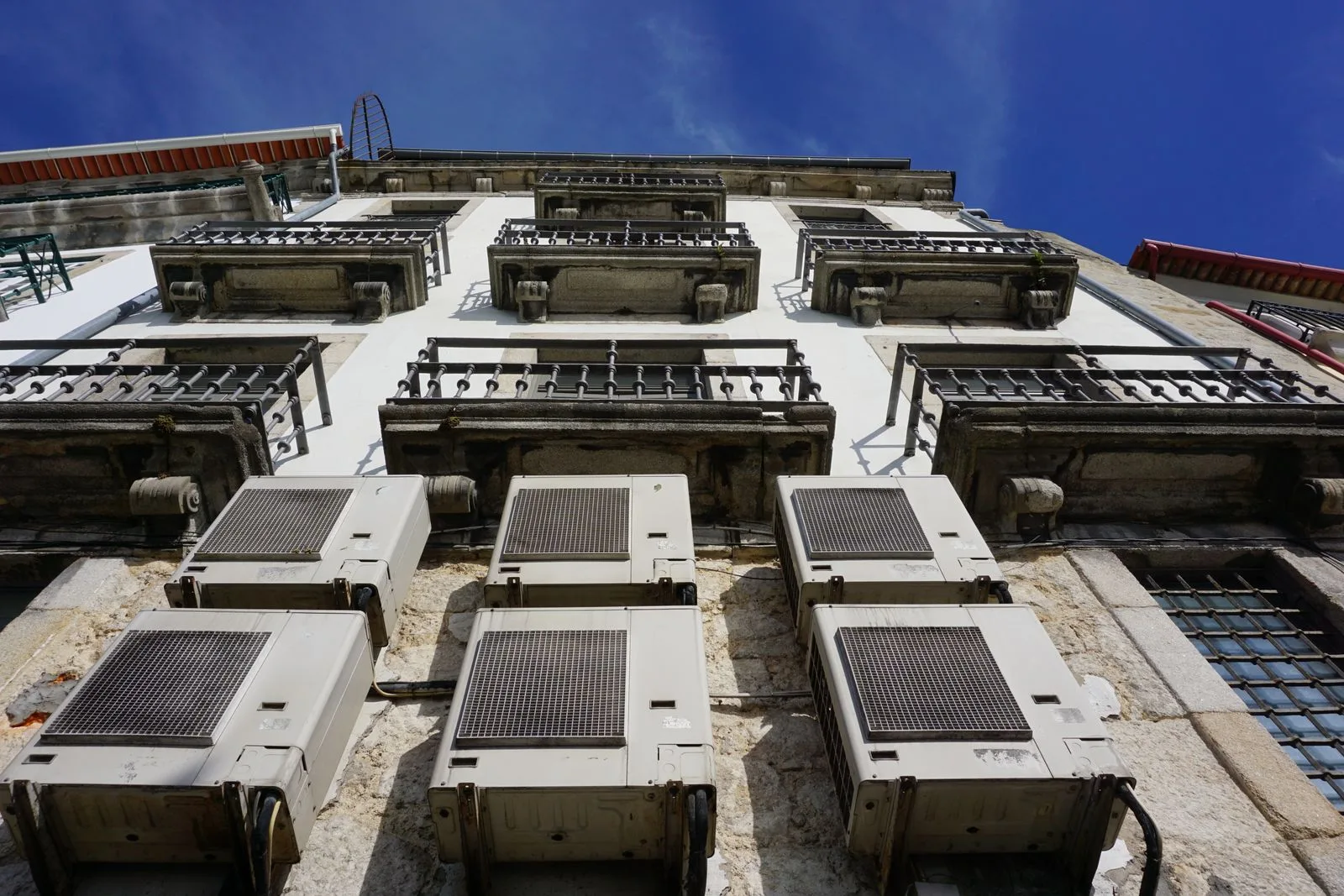
America has a crude answer to summer: it switches on the air conditioning. According to the International Energy Agency, about 90% of US households have it. In Europe, the figure is 23%.
The Commission knows exactly what that looks like on the ground. A report from its Joint Research Centre and Energy Poverty Advisory Hub found that in 2023, 26% of EU households said they could not keep their homes comfortably cool in summer. Among the poorest fifth, it was nearly 35%.
Yet in European policy circles, cooling is still mostly treated as a problem for the grid rather than a lifeline for a widow on the fourth floor. Air conditioning is something to be kept efficient, kept rare and kept slightly embarrassing. Most Americans of 85 in Phoenix get through July with a cold room and a remote control. Too many Europeans of 85 in Milan get a leaflet telling them to drink water and close the shutters.
The other season
There is one more figure the summer coverage leaves out. In 2023, many of the same scientists published a study in The Lancet Planetary Health on the same 854 cities. Across 2000 to 2019, they found that cold killed roughly ten times as many people each year as heat.
That is not a reason to shrug at 50,000 summer deaths. It is a reason to see that both are, in large part, the same problem: old and poor people in homes they cannot afford to heat or cool. Temperature kills where energy is dear and buildings are bad.
And energy in Europe is very dear. Gas prices are up 140% since the war on Iran began, gas storage is at its lowest since 2011, and EU energy ministers meet on 29 October to discuss asking households to use less, according to Euronews. A continent that makes power expensive makes both seasons more dangerous.
What arrives on Wednesday
So what is Brussels' answer to the deadliest summer on record? On 28 October, according to the European Parliament's legislative tracker, the Commission is due to present its integrated framework for climate resilience.
The legislative part, as the tracker describes it, would set a common climate reference scenario based on 3°C of global warming by 2100. It would oblige the EU and member states to assign "risk owners" for every major climate risk, in sectors from public health to defence. And it would require national "climate resilience strategic plans".
Some of this is sensible. Planning for a hotter Europe is better than pretending otherwise, and at least the Commission has noticed that adaptation is not defeatism. But notice the form the response takes: a scenario, a duty, an owner, a plan. Paperwork about risk, rather than a cooler room for the person facing it.
A serious answer would look less like a regulation and more like a checklist. Cheaper electricity, so people can afford to run a cooler. Cooled rooms in every care home and in public housing, made mandatory and funded. Daily checks on the isolated elderly during heat alerts. Trees, shutters, insulation. None of it requires a 3°C reference scenario. Almost all of it is a national or local job, which is precisely where Brussels should stop and let governments be judged on whether they did it.
Fifty thousand people did not die this summer for lack of a risk owner. They died mostly old, mostly in cities, in heat they had no way to escape. Europe can fix that by next June, if its leaders spend less time owning the risk and more time switching on the air conditioning.