
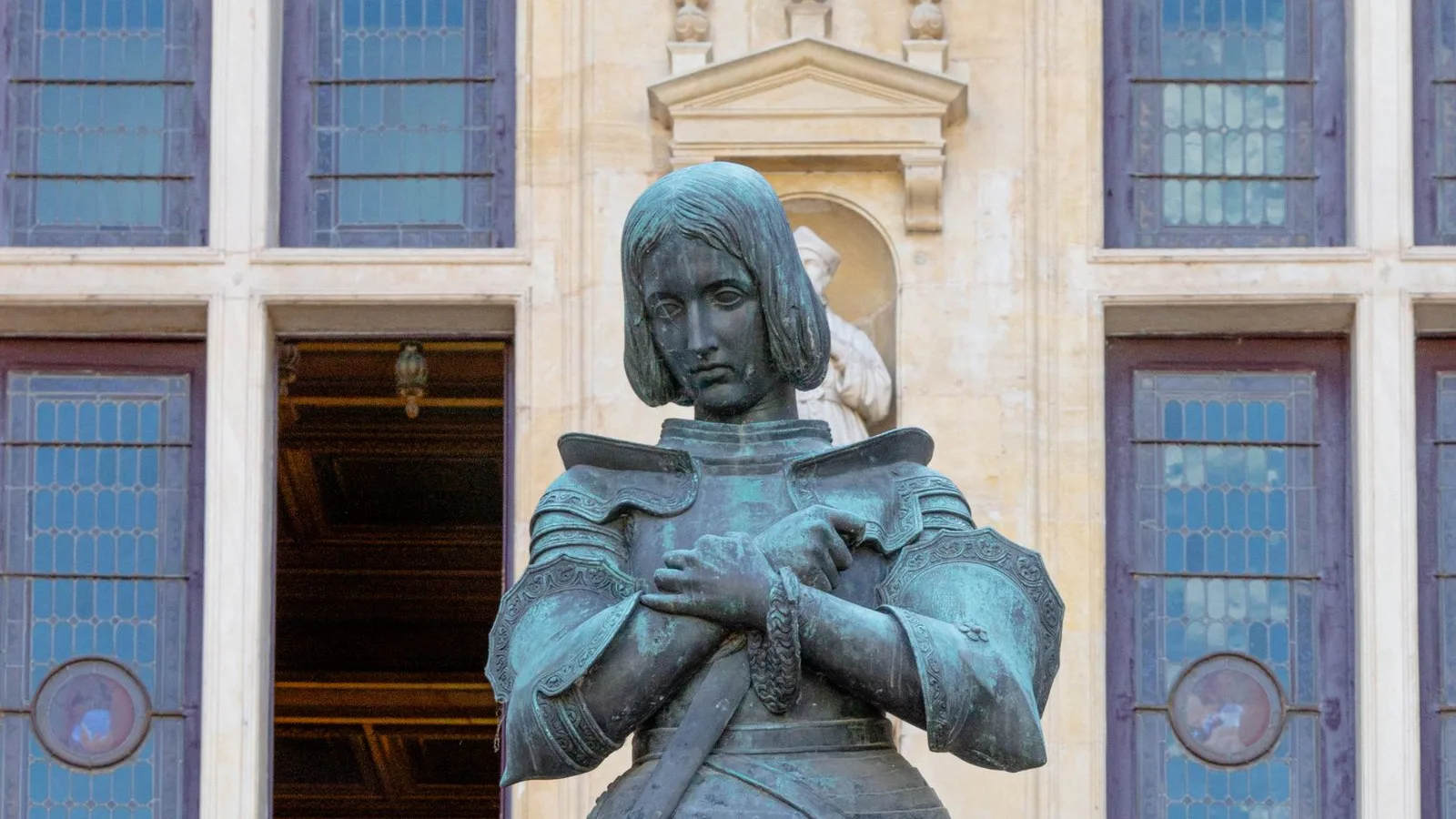
Marine Le Pen chose her city with care. Orléans is where Joan of Arc broke an English siege in 1429, and on Sunday, in the city's Co'Met arena, the frontrunner for next spring's French presidential election spent the best part of an hour on the theme of rebirth. Joan of Arc, the Renaissance, "new obscurantisms", a France that is going forward, not back. "It was good before, it will be better tomorrow," she told supporters. Bardella put the crowd at 8,500. AFP said about 10,000.
Most of it was mood music, and deliberately so. Le Pen is polling at 32 to 34 percent in the first round, according to an Ipsos survey cited by AFP. Frontrunners don't need to shout. She did not even repeat her old promise to bring the retirement age back to 60, Reuters notes. She now only promises not to push it above 64.
But one sentence was not mood music. It was a plan.
The sentence that matters
Speaking about France's constitution, Le Pen said: "No text, no authority, and above all no foreign one, not even a European one, will be superior to it," Reuters reports. In the same speech she promised to write "the national community" into the constitution, according to BFMTV, and praised the referendum as a way to "give power back to the people".
Put those together and you have a route a president could actually take. Change the constitution, put it to the voters, then tell Brussels that where EU law collides with it, EU law loses. Reuters' own reading was that it points to a head-on clash with the EU if she wins.
That fits what she told Brussels to its face. On a visit on 12 October, Euronews reports, she compared the Commission to La Fontaine's frog that puffs itself up to the size of an ox. She also promised to cap France's net payment to the EU at €5 billion a year, down from about €8 billion on the French Senate's figures, and to stop French funding for Ukraine.
Poland has already tried this
None of this is new territory. In October 2021, Poland's Constitutional Tribunal, then packed by the Law and Justice government, ruled that parts of the EU treaties were incompatible with Poland's constitution. The Commission took Poland to court over it in 2023. Last December, the EU's Court of Justice ruled that Poland had broken its obligations. Warsaw spent those years at war with Brussels, with billions in EU recovery money frozen over the state of its courts.
The Le Pen camp will say France is not Poland, and on one point it is right. Poland was a net recipient, so Brussels could squeeze it through its funding. France is a founding member and a net contributor to the EU budget. Brussels has far less to withhold from a country that pays in more than it gets back. In a primacy fight with Paris, the side holding the wallet would be France.
That is what should worry Brussels. Not that Le Pen will lose that fight, but that she might win it.
"Because it is France"
And here is the uncomfortable part for the Commission. It has spent years teaching France that the rules bend for it.
In 2016, Jean-Claude Juncker, then Commission president, was asked why Paris kept getting extra time on its deficit. "Because it is France," he answered. France's debt and deficit are still above EU limits today, and the bond market has noticed even if Brussels has not, as we wrote on Friday. France's voters have their own memory of how Europe treats them. In 2005 they rejected the European constitution by 55 percent, and much of it came back anyway as the Lisbon Treaty, ratified by parliament rather than the people.
So when Le Pen says no European authority will outrank France, many voters will hear nothing radical. They will hear a description of how things already work, plus the grudge of 2005. She is offering to make permanent, and official, the exemption Brussels has been handing out informally for a decade.
There is a centre-right case against an overreaching Commission, and the frog fable makes it rather well. Brussels does creep into health, security and foreign policy. The honest fix is to roll that back in the treaties, with allies, country by country. A unilateral "France first" clause ends where Poland ended: in court, alone. And the first uses Le Pen has announced for her recovered sovereignty are stopping French funding for Ukraine and pushing to end EU sanctions on Russia. Sovereignty spent on the Kremlin's wish list is a strange kind of rebirth.
The court she would have to trust
There is one more irony, and Orléans did not dwell on it.
The authorities that will decide whether Le Pen runs at all are French ones. In July, a Paris appeal court convicted her of embezzling European Parliament funds and sentenced her to three years, one of them to be served under electronic tag. She denies wrongdoing and has appealed to the Cour de cassation, which suspends the sentence. It will hear her constitutional challenges on 16 December and has promised a ruling before the first round on 18 April, RTL reports. Among the 13 appeals before that court, Le Parisien reports, is one lodged by the European Parliament itself, as a civil party.
So the "European authority" in Le Pen's life is not only the Commission. It is also a civil party in a French courtroom, pursuing its own appeal before French judges. That is the rule of law she promised on Sunday to "restore". She will have to accept the verdict.
The test from Friday
One more thing was missing from the stage. Two days after a gunman killed a young man and gravely wounded a 12-year-old girl in Trappes and La Verrière, in what Macron and the anti-terror prosecutor treat as a racist attack, Jordan Bardella did bring it up. "In Trappes, two days ago, barbarism struck again," he said, BFMTV reports, without naming the racist motive. Then he moved on to the riots.
We wrote on Saturday that the harder sentence had to come from that stage. Barbarism is the right word. It is not the whole sentence.
Joan of Arc relieved Orléans from a foreign army. The European Union is not one. France signed every treaty it is bound by, and in 1992 it approved Maastricht by referendum. If Le Pen wins, the real question will not be whether France outranks Brussels. It will be whether she can make that case to 26 other countries without ending up where Poland did.
She may well manage it. France has the wallet, the seat at the UN Security Council and the bomb. But a whole country's place in Europe is a lot to bet on one sentence in Orléans.