
For three years the European Union has had a name for the Russian defence ministry's shipping company. It sits on the EU's consolidated sanctions list as LLC "Oboronlogistika", listed in December 2023 and described as a "shipping company established under the Russian Ministry of Defence". Its assets in Europe are frozen.
Its ship, the Sparta II, never made it onto an EU list. So it kept doing what it has mostly done since late 2022: shuttling between St Petersburg and Kaliningrad, past the coasts of Finland, Estonia, Latvia and Lithuania, four EU and NATO members that had all signed up to the sanctions on its owner.
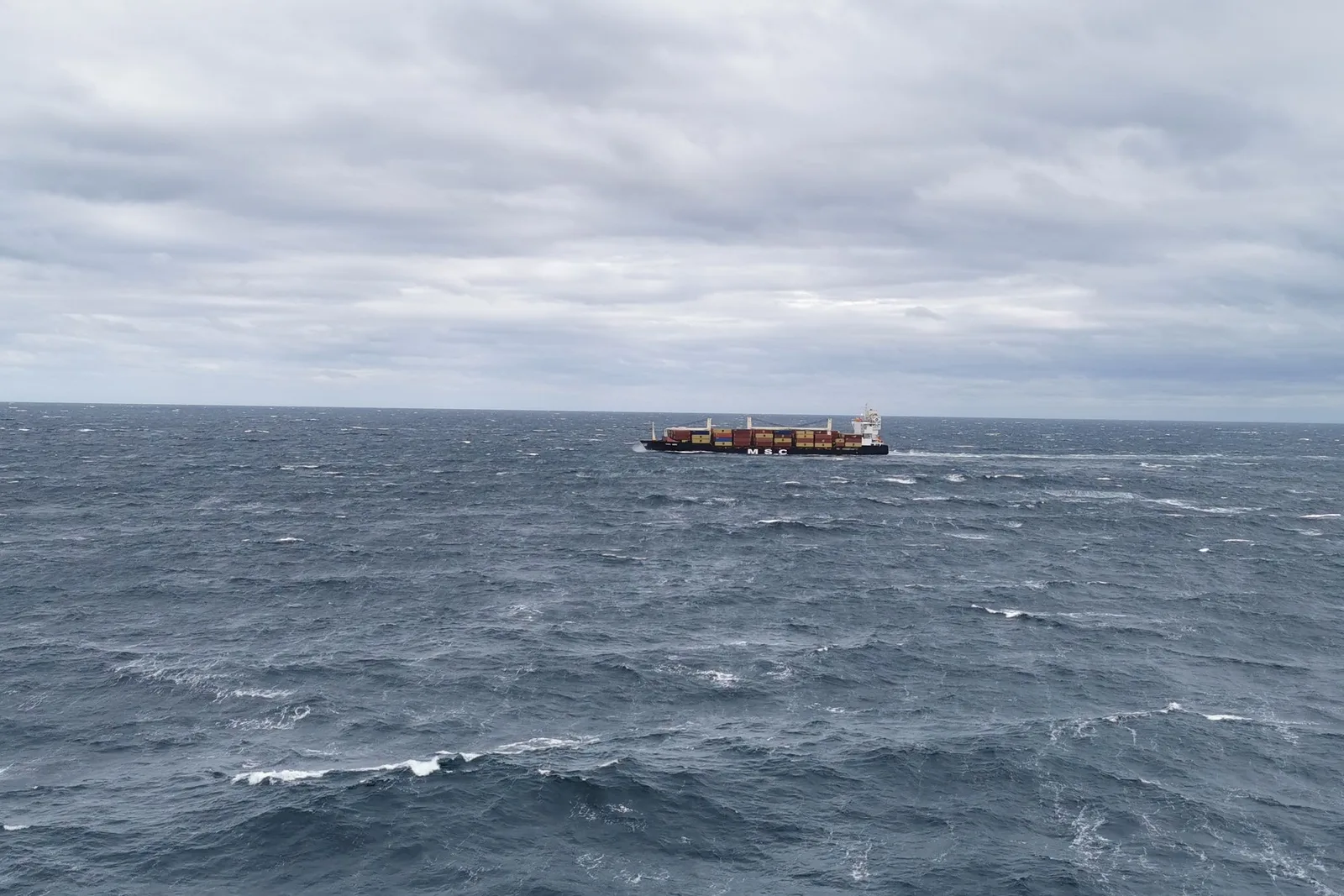
On Saturday morning, shortly before 9am local time, two drones found it about 50km west of the Russian island of Gogland, in what Finland's defence ministry called international waters. The Sparta II caught fire, lost steering and drifted into Finnish territorial waters off Loviisa. Its 16 crew were evacuated to a Russian vessel. Finland's armed forces said Ukraine was likely behind it, the BBC reports. Kyiv has not claimed it.
Europe sanctioned the owner. Somebody else enforced it.
A ship Washington named in 2022
None of this was secret. On 8 May 2022, ten weeks into the full-scale invasion, the US State Department designated Oboronlogistika as the Russian defence ministry's sole provider of troop transport to certain regions and of military cargo to occupied Crimea. In the same announcement it listed three of the company's vessels as blocked property. The first one named was the Sparta II.
Ukraine's military intelligence keeps a public file on the ship. It says the Sparta II carried weapons, including S-300 air-defence systems, from Syria to the Russian port of Novorossiysk in August 2022, and has worked the Ust-Luga–Baltiysk–Kaliningrad line since that November. Helsingin Sanomat reports that, by Russian government order, Oboronlogistika has been the only company carrying the defence ministry's sea freight to Kaliningrad since 2019.
Finnish coastguard commanders said on Saturday that the vessel was known to have been used to carry weapons, while stressing that nobody yet knows what was in its containers this time. Russia's state news agency TASS, citing a single unnamed source, said paint.
Washington listed the ship. Kyiv listed the ship this year. According to two sanctions-tracking databases that mirror the official lists, neither the EU's vessel list nor the UK's includes it. Brussels froze the company's bank accounts and let its hardware sail.
Helsinki said it; Brussels didn't
What happened next was a test of European nerve, and Finland passed first. "War is spilling over into our immediate vicinity," Prime Minister Petteri Orpo wrote on X. "Ukraine has the right to fight back against the aggressor."
No hedging, no "deep concern", no call on "all sides". A Finnish head of government, with a burning Russian ship anchored in his own waters, said out loud that the invaded country is entitled to fight back, even when the fight arrives off Finland's own coast.
Defence Minister Antti Häkkänen added the uncomfortable part. He told Helsingin Sanomat that security in the Gulf of Finland had become more serious, and that he did not expect drone strikes on Russian ships to remain one-offs. A few hours after the strike a Russian helicopter flew 4.1km into Finnish airspace, which Häkkänen said was "possibly" linked to the rescue or monitoring operation. President Alexander Stubb called the events serious and said he had briefed Finland's allies.
From the EU's top floor, by Sunday morning, we could find nothing. No statement from foreign-policy chief Kaja Kallas, an Estonian who knows exactly where the Gulf of Finland is. Nothing from the Commission. The bloc that has passed sanctions package after sanctions package had no view, apparently, on what happens when someone treats one of its listed companies as an actual enemy asset.
The fair objection
There is a serious case for nervousness, and Finland itself has made it. When a Ukrainian drone hit a Russian warship in the Gulf of Finland earlier this month, Helsinki raised concerns with Kyiv. The Baltic is one of the busiest seas in the world: the Helsinki–Tallinn ferry route alone logged 7.5 million passenger crossings last year, Al Jazeera notes.
And Saturday showed the risk. A ship with unknown cargo drifted into a NATO country's waters on fire. "If there is explosive cargo, the ship can explode," the Border Guard's Ilja Iljin told Helsingin Sanomat (our translation), adding that there are perhaps a few dozen tonnes of oil in its tanks. A Russian helicopter crossed a NATO border, a day after Russian missiles came down in Poland. Nobody in Helsinki wants the Gulf to become the next Black Sea.
But notice whose risk that is. Finland is carrying it either way, because the Sparta II was never going to stop sailing past Loviisa on its own. The question for Europe is not whether Ukraine should have done it. That is Kyiv's war and, as Orpo said, Kyiv's right. The question is why a ship that the US identified as Russian military logistics in 2022 was still, in practice, treated by Europe as just another freighter in 2026.
What Brussels could actually do
Sanctions are not boarding parties, and the law of the sea gives even ugly ships rights of passage. But the EU has tools it has not used here.
Lawyers will point out that the EU's freeze on Oboronlogistika already covers the company's property inside EU jurisdiction. That is exactly the problem: a ship sailing from one Russian port to another never needs to enter it.
So list the hull itself. The EU can add the Sparta II, and every other vessel Oboronlogistika controls, to the list it already uses against Russia's shadow tankers, cutting them off from EU ports and EU services. That alone would not stop a Russian-flagged ship sailing between Russian ports. It would end the pretence that Europe had not noticed it. It can ask Baltic navies and coastguards to track listed military-logistics ships as closely as they now track Russia's ageing tankers. And when a member state's prime minister says the war has reached his coast, the EU's foreign-policy chief can say something before the fire is out.
Ukraine has just done Europe's enforcement with its own drones. The least Europe can do is finish its own paperwork.